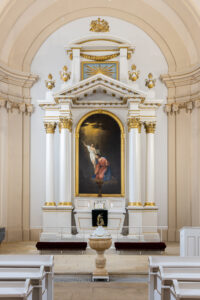
The Unitarian Church of Cluj-Napoca, built between 1792 and 1796, stands as the most significant urban Unitarian place of worship in Transylvania. Its construction marks a period of consolidation and visibility for the Unitarian community, which had long been present in the region but only gradually gained broader acceptance. Positioned in the heart of Cluj-Napoca, the church reflects both the religious identity and the civic importance of the Unitarian congregation.
Architecturally, the building is a refined example of late Baroque style, characterized by balanced proportions, elegant simplicity, and restrained decorative elements. Unlike the heavily ornamented Baroque churches found elsewhere in Europe, this structure maintains a sense of clarity and order, aligning with Unitarian principles that emphasize rationality and moderation. The façade, with its harmonious lines and subtle detailing, conveys dignity without excess, while the interior space is designed to support both communal gathering and focused reflection.
The church also symbolizes the growing recognition of Unitarianism following the Edict of Torda, a landmark moment in the history of religious tolerance in Europe. This decree allowed for the free practice of several denominations, including Unitarianism, and laid the groundwork for the development of a distinct Unitarian tradition in Transylvania. The later construction of such a prominent urban church demonstrates how these early principles of tolerance eventually translated into institutional and architectural expression.
Today, the church remains an active center of worship and cultural life. Beyond its religious functions, it hosts community events, concerts, and gatherings that continue to reinforce its role as a living institution. As both a historical monument and a vibrant spiritual space, it embodies the enduring legacy of Unitarianism in Transylvania and its ongoing contribution to the cultural fabric of the region.